We are at the start of a “third revolution” in immunology. The first revolution took a “divide and conquer” approach and unveiled the foundational working parts of the immune system and how they fit together. Then, systems immunology allowed us to move from studying the parts to creating comprehensive atlases of the cells and molecules involved in the human immune response.
Now, the field is at a critical inflection point. With the AI and bioengineering tools and concepts in place, we can make immunology a predictive, not just descriptive, science. Beyond immediate prediction, this new era offers the chance to synthesize the vast and disparate knowledge of immunology into a coherent set of principles. The ultimate goal is a unified conceptual model of immunity, enabled by AI, that allows us to make the fundamental leap from understanding the immune system to engineering its outcomes for human health.
Here are five core ideas, described in depth in a perspective article on arXiv, to help close the gap between today’s static cellular atlases and the dynamic AI models of the future.
1. A perfect storm: The convergence of AI and immunology
The last decade saw parallel, explosive breakthroughs in two fields. AI evolved from simple neural networks to the powerful Transformer architectures that drive large language models. Simultaneously, immunology delivered revolutionary treatments like immunotherapies and CAR-T therapies.
Surprisingly, these timelines existed without significant interplay. Now is the time to bridge them. By creating touchpoints between these fields, AI can solve the next generation of immunological problems, and the elegant logic of the immune system can inspire the next generation of AI models.
2. From bytes to B cells: Forging a common language
To merge these timelines, we need to develop a shared language for the AI and immunology communities. With that language, we can talk about what problems are worth pursuing with AI and what technologies immunologists should think about adopting. We need to find ways to work across AI and immunology so that the sum is greater than the individual parts. The success of AlphaFold is a perfect example. It combined a well-defined biological problem (protein folding), the right data, and the right AI models to make a transformative leap.
We have the same opportunity for the hardest problems in immunology. By building a collaborative community around the right data and models, we can replicate this success.
3. Building causal data engines (not just bigger datasets)
Machine learning isn’t new to biology, but what’s been missing is the application of the predictive capacity of AI to immunology. To do that, we need causal data — data that is collected or structured with the explicit goal of understanding a cause-and-effect relationship.
We’re in a technological age where we can engineer platforms to generate the causal data we need to solve these problems. Here at Biohub, across four scientific grand challenges, our teams are engineering exactly those types of platforms — imaging, cell, and bioengineering platforms — to generate specific, causal data to use in AI models in immunology.
4. Building with biology: AI models that match biology
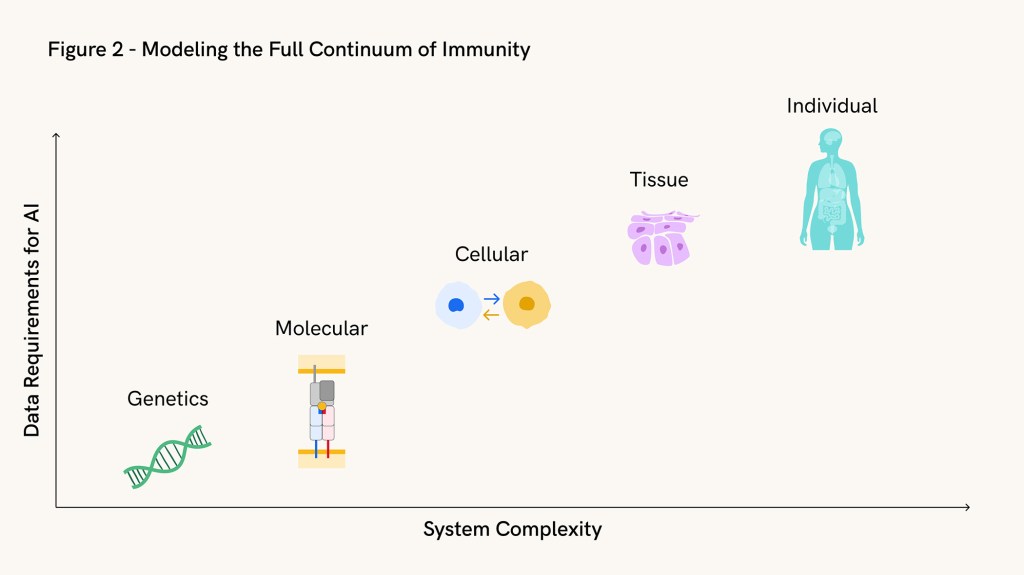
With the right data, we need the right models. The immune system is complex across multiple axes: from genetics and molecular interactions to cellular decision-making and tissue-level dynamics. Once we have causal data, modeling is where we can shift immunology from descriptive to prescriptive. But we have to be very deliberate and intentional in choosing the right AI tools.
In a recent perspective article, our team lays out five axes of complexity across the immune system: genetics, molecular interactions, cellular decision-making, tissue-level organization, and system dynamics. A chosen AI model must be biologically informed by which of those areas one is exploring. For example, for the language of DNA or RNA and proteins, architectures such as the Transformer will be powerful. But to model cellular decision-making, we’ll need a different class of models, such as diffusion models that can capture the full probability distribution of the trajectories of cells.
5. The engine of discovery: The ‘Predictive Immunology Loop’
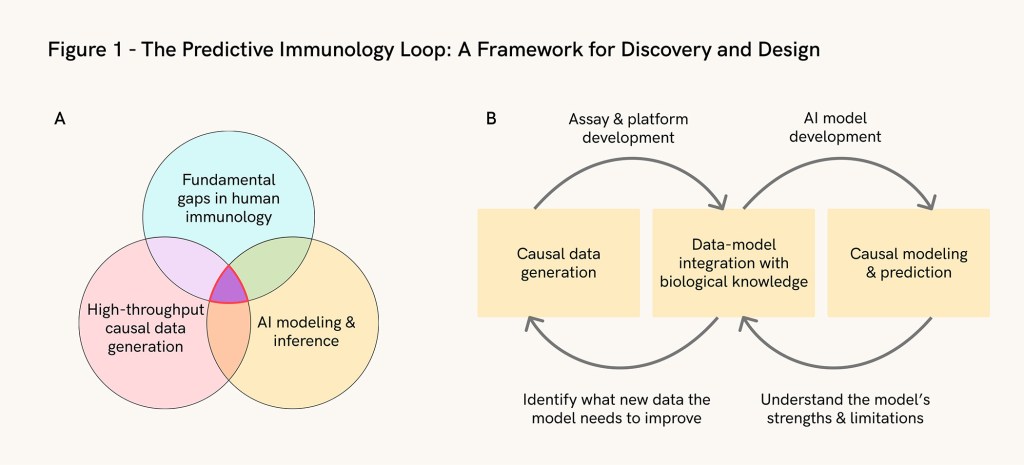
If we generate the right data and model it with the right AI tools, we can make predictions that then advance the next level of understanding, such as designing the next experiment faster or resolving some observation in a system.
This virtuous loop should feel familiar, as there are already parts of science that operate this way: Engineer platforms to generate data, build models to accurately represent that data, use those models to make predictions about the system, then use those predictions to inspire us to generate new types of data. This Predictive Immunology Loop is an engine that can help us ultimately understand the whole system, and predict how it is going to behave.
With an engine to power predictive immunology, we may soon be able to resolve some of the hardest problems in human immunology, such as how and why small changes in the genome affect the immune system; how to directly and quickly design drugs based on how cells recognize antigens; and which therapeutic interventions can revert cells from an inflamed to healthy state, or even prevent inflammation in the first place.
6. A new model for collaboration will galvanize the field
A century of work has brought us here, yet the scale of these problems is too large for any single lab to accomplish alone. This challenge requires a new model of science. To catalyze this change, Biohub is building the foundational AI engine for this new era of predictive immunology. Our commitment is to engineer the core platforms that generate causal data, to develop the biologically inspired AI that can interpret it, and to create the shared, open resources that will make these capabilities accessible to the entire scientific community.
We believe that providing this core infrastructure will empower researchers everywhere to ask their most ambitious questions, test novel hypotheses, and ultimately contribute to a richer, more predictive understanding of the immune system. We have seen the power of this collaborative model in our programs like the Billion Cells Project and Rare As One Network, where combining data, tools, and community expertise is already accelerating progress. By building the engine and opening it to the world, we can collectively achieve the ultimate goal: a virtual immune system that helps us engineer better health for all.
Aly A. Khan is Biohub’s senior director of artificial intelligence and an assistant professor at the University of Chicago.