One of our goals is to learn from the community by holding small workshops. For this second workshop in the series we’ve planned, we brought together leading scientists working on computational tools for microscopy to discuss how to make it easier and faster for biologists to analyze, visualize and share microscopy data.
Cori Bargmann: Optical imaging is transforming biology. We have new microscopes with incredible spatial and temporal resolution, and new fluorescent indicators that make cells — and the structures inside them — light up. Biological processes that were once snapshots are now movies that we watch in real time. But collecting the data is just the beginning. There are enormous challenges in visualizing this information as well as automatically finding and measuring features like the boundaries of a cell or the speed at which a molecule is moving. It’s exactly the kind of problem spanning science and engineering that we’re excited about at the Chan Zuckerberg Initiative.
As we described in our last post, one of our goals right now is to learn from the community by holding small workshops. For this second workshop in the series we’ve planned, we brought together leading scientists working on computational tools for microscopy to discuss how to make it easier and faster for biologists to analyze, visualize and share microscopy data. The inspiring group included software developers building tools for analysis, visualization and hardware control, biologists building and using cutting-edge microscopes, and industry experts on deep learning and other modern machine learning techniques, across a range of ages — from grad students to faculty.
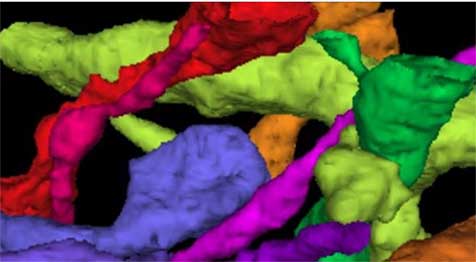
We spent two days discussing the current state of the art, and where the field might head next. In a demo session, each group showed us their latest and greatest tool, or their coolest new data set. The line-up included a new flood filling machine learning algorithm for tracing neurons in dense 3D microscopy images, a software tool that lets biologists construct their own pipelines for microscopy analysis, and data from the lattice light-sheet microscope, which lets us watch cellular processes at incredibly high resolution, like this immune T cell engulfing an antigen presenting cell.
By the end of the workshop, a few key themes emerged. First was the value of benchmark datasets and competitions, which have been crucial in machine learning to standardize problems and crowd-source solutions, but have not yet taken off the same way in the world of microscopy.
Second was the issue of interoperability across the current software stack, which currently spans a wide range of programming languages and approaches; we heard many creative solutions, both social and technical, and are excited to see where this community can go from here.
Third was the value of bringing new kinds of expertise together in this space, whether it’s better connecting software developers with the wide variety of biologists using their tools, or linking researchers and tool developers in academic settings with industry experts in cloud computing or machine learning — something we hope to help with at the Chan Zuckerberg Initiative!